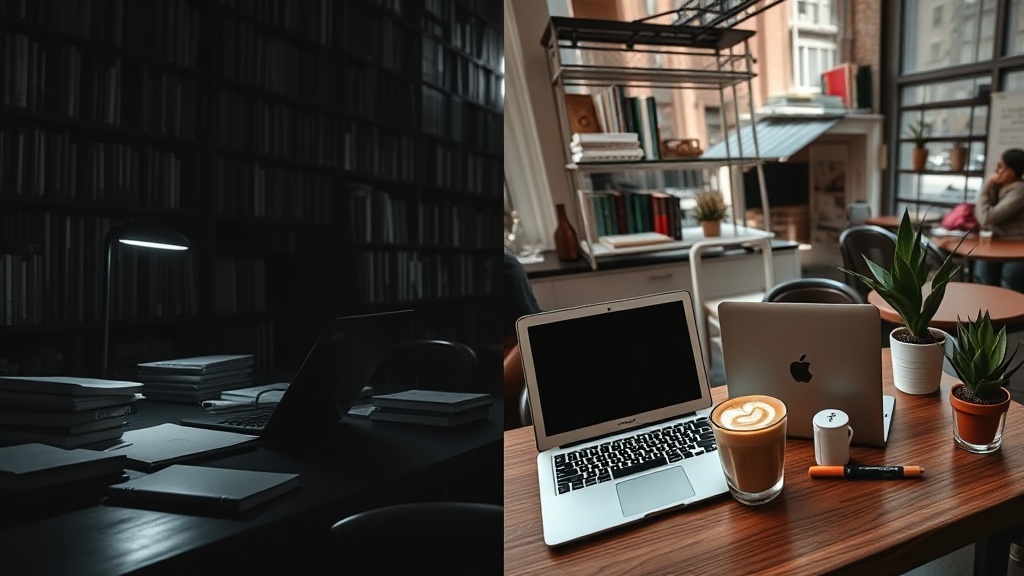
Library vs. Coffee Shop: Where You Actually Study Best (And Why You're Probably Wrong About It)

Midterms are coming, which means your Instagram is about to fill up with the same photo it fills up with every semester: a MacBook, a latte with foam art, maybe a candle if they're really doing it. Some ambient lo-fi playlist humming in AirPods. The caption will say something like "grind szn 🤍📚" and get 200 likes.
I've posted that photo. I'm not here to shame you.
I'm here to tell you it might be making you worse at studying.
Yesterday's post was about desk setups — the elaborate, aesthetic, almost ritual construction of the perfect study environment. A bunch of you DMed me asking where you should be studying, so this is the follow-up nobody asked me to write but everyone needs to read before midterm chaos starts. Because the answer is more complicated than "library good, coffee shop chaos," and anyone who tells you otherwise is selling you a vibe, not a strategy.
The Instagram Lie (And What the Research Actually Says)
Let's start with the data, because I went and found it so you don't have to.
Research on environmental noise and cognitive performance suggests that sustained analytical work — the kind you need for problem sets, reading comprehension, anything requiring actual retention — tends to be harder at higher ambient noise levels. Studies typically cite the relevant range as around 65–70 decibels, though individual variation is real and the research isn't perfectly settled. Coffee shops generally run louder than libraries; rough estimates put average coffee shop ambient noise around 70–80 dB and library quiet floors considerably lower. Take those figures as directional, not gospel — actual levels vary a lot by time of day and the specific space.
So the coffee shop isn't wrong, exactly. It's just often wrong for the task you're trying to do in it.
There's also research on attention and social evaluation — the cognitive cost that comes from being observed while you work. When you're in a public space, part of your brain runs a background process assessing how you appear to others: Do I look focused? Does my screen look productive? That overhead isn't free. Whether it rises to the level of significant distraction depends on the person and the task, but it's worth factoring in.
I talked to nine students this week — informally, at Bobst and at a couple of coffee shops near campus — about their actual study patterns versus what they post. This isn't a controlled study; it's a snapshot. But: seven said they get more done at the library. Five said they go to coffee shops "to feel motivated." Two said, unprompted, that they "get less done but feel better about it."
That gap — between feeling productive and being productive — is where the Instagram aesthetic lives.
The Social Dynamics Nobody Talks About
Here's the thing about libraries that people treat like a weakness: the anonymity.
At a coffee shop, you're at a table. People can see your screen. There's a low-level social contract that you're all there doing something productive and creative and important. You're performing studiousness to an audience of strangers, and they're performing it back at you.
This sounds like accountability. It is not accountability.
Real accountability is having someone who knows you check whether you actually finished your outline. Performative accountability is looking around and seeing that other people also have their laptops open and therefore feeling like you're part of some shared productive moment — even if you've spent the last 45 minutes cycling between the same three tabs.
Libraries create what I'd call anonymous accountability — you feel the pressure to work without the pressure to look good doing it. No one cares what's on your screen. No one is watching. The quiet itself is a social norm that enforces focus without the performance overhead.
The TikTok "study with me" genre has genuinely warped how we think about study environments. When we see enough videos of people in soft lighting with oat milk lattes looking productively beautiful, we start to believe that's what studying effectively looks like. It isn't. It's what studying looks like on camera.
The Real Trade-offs (Honest Version)
I'm not anti-coffee shop. I'm pro-honesty about what each environment actually gives you.
The library:
- Quiet floor = noise levels that tend to support analytical processing
- Zero marginal cost (your tuition already paid for it)
- Socially anonymous — lower performance overhead
- Can feel isolating if you're already in a spiral
- No ambient stimulation if your brain needs a warm-up
- The late-night Bobst floors develop their own distinct energy, but that's a different story
The coffee shop:
- Moderate ambient noise is genuinely useful for creative tasks, per the research above
- Social energy can help with activation if you're stuck in avoidance mode
- The cost of a drink creates mild commitment pressure — which is real, if slightly absurd as a productivity strategy
- You will almost certainly be distracted more often
- Great for group work because nobody's giving you side-eye for talking
- Less ideal for anything requiring sustained reading or retention
Neither of these is a moral position. They're environmental tools, and tools work best when you match them to the job.
Match the Task to the Space
This is the part I wish someone had told me freshman year.
Here's my actual framework, built from embarrassingly specific personal experience and whatever research I could access through NYU's databases:
Go to the library for:
- Problem sets and anything requiring analytical processing
- Timed exam prep (you need quiet to simulate exam conditions)
- Dense reading with actual comprehension goals
- Data analysis, coding, anything where errors have consequences
- The final sprint before a deadline
Go to the coffee shop for:
- Brainstorming and early-stage outlining
- Creative writing when you need to break through a block
- Group project meetings (everyone can talk, nobody's whispering apologetically)
- Starting a task you've been avoiding (a change of environment can genuinely help break avoidance patterns)
- Low-stakes review when you need ambient energy to stay awake
The research does support this split: moderate ambient noise can increase abstract thinking and creative problem-solving for some people. If you're staring at a blank Google Doc trying to figure out your thesis structure, a coffee shop might actually help. Once you know what you're writing, go to the library and write it.
The Hybrid Play (The Actual Pro Move)
The students I know who are genuinely good at studying don't pick one environment and evangelize it. They use both, deliberately, based on what they're working on.
My personal schedule for midterm week, which I have mapped out in a way that is probably unhinged but works:
Morning at the library (9am–noon): dense reading, problem sets, anything analytical. Quiet floor, phone face-down, notifications off. This is real work time.
Midday coffee shop visit (optional, 30–45 min): brainstorming, journaling, outlining. I bring a notebook, not a laptop. This is creative time.
Afternoon back to the library: whatever deadlines are pressing. Same rules.
The coffee shop is not my study space. It's my activation space — the place I go when my brain needs permission to be messy before getting serious.
The Part Where I Actually Challenge You
Before you post your midterm coffee shop setup this weekend — and you will, I'll see it — ask yourself what you're actually trying to accomplish in the next two hours.
If it's brainstorming, creative thinking, or getting started on something you've been avoiding: the coffee shop is the right call. Go. Enjoy your latte.
If it's understanding a textbook chapter, grinding through problem sets, or writing the actual draft of that paper: you don't need the aesthetic. You need the quiet floor at Bobst and a water bottle.
The truth is, the Sunday night dread that hits before deadlines isn't about where you study — it's about starting too late. But picking the right environment for each phase of work can at least make the actual studying less painful.
The coffee shop aesthetic isn't a lie — it's just a tool being misapplied. Choose your environment based on the task, not the Instagram opportunity. The photo can wait until after you've actually done the work.
And yes, the latte will still look good at 3pm.
Have a study environment take? A campus spot that genuinely works for specific tasks? Drop it in the comments — I'm putting together a campus-specific study location guide and want real data, not just aesthetics.
You Might Also Enjoy
- The Library Desk Setup Has Gained Consciousness and I Have Notes — The foundation post about why your study setup matters (and when it doesn't)
- The 2AM Library Is a Different Planet (I Documented It) — What actually happens in Bobst during peak midterm chaos
- The Sunday Night Dread Is a Medical Condition and I Won't Be Taking Questions — Why timing + environment matters more than motivation