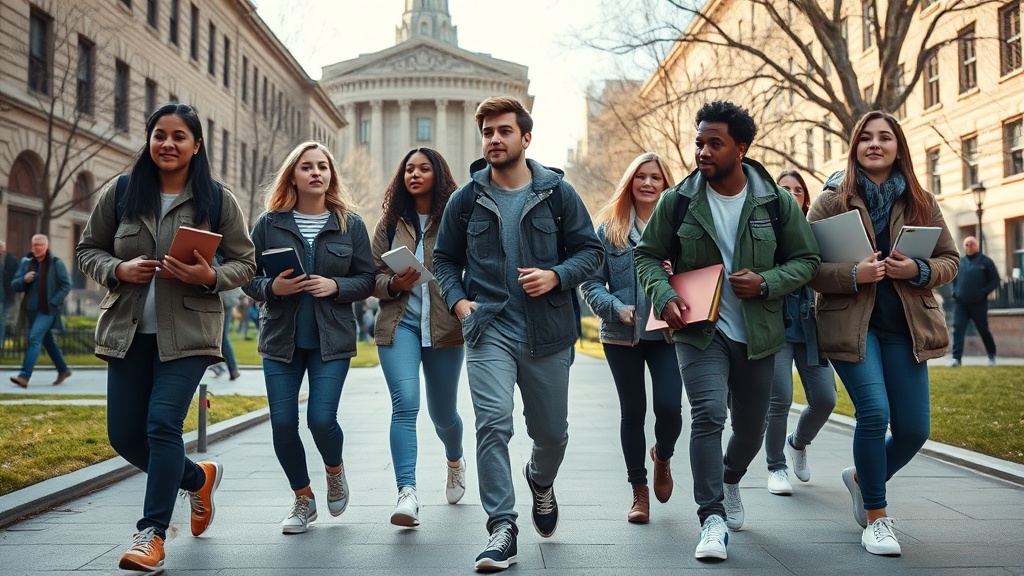
The Campus Uniform 2.0: Why Everyone on Campus Is Dressing to Move

The Campus Uniform 2.0: Why Everyone on Campus Is Dressing to Move
I know, it looks weird when I say this out loud: you can now understand a whole class from the way people are dressed at 9:40 a.m.
No because I was walking through a random Monday on my way from class to the coffee stop, and I counted 100 people across three blocks who were basically carrying the same message:
- Oversized utility jacket or “just-there” hooded shell
- Straight-leg trousers or cargo-legged fallback pair
- Soft sneakers or retro running shoes
- Big bag, charger, notebook, two pens, one emergency snack
Same not by accident. This is not a coordinated style cult. This is a campus adaptation.
Welcome to Campus Uniform 2.0.
The old school of college style was “look put together, but not trying too hard.”
The new school is “look functional, but also be readable as a person with standards.”
That distinction sounds like semantics until you actually spend a day tracking the trend.
I literally counted 100+ people before I understood it
On Thursday last week, I did one field pass from one end of Broadway to the other and ended up with a mini dataset:
- 39 students in layered jackets with matching “study-ready” silhouettes (light jacket + bag + shoes)
- 26 students in a sneaker + track-leg pairing that clearly came from one practical mindset (comfy but not chaotic)
- 17 students in full “I can sit in a lecture, stand in a cold draft, and sit on a 2nd-floor stair landing” systems
- 9 students with no visible coat, clearly early adopters who got the weather wrong
The outliers were still part of the same grammar.
This is not fashion laziness.
It is social logistics.
Why this style works better than you think
1) We moved from “wardrobe decisions” to “mobility decisions.”
The calendar has become too fragmented for “get changed for every context.”
One hour of lecture, then a quick walk to a coffee shop, then library sprint, then a friend’s dorm meeting, then a gym session, then maybe a night event. If your outfit can survive all of that, it wins.
The utility layer does that.
The old campus coat was for weather. Today’s shell is weather-plus-schedule.
2) Climate is weird, and this style handles ambiguity.
March isn’t committed to anything. It’s not cold enough for full winter armor, not warm enough for summer ease.
So students are building wardrobes for “could be either.”
That’s why you see:
- Midweight materials
- Adjustable waist or drawstrings
- Easy layering without needing a formal transition
- Shoes that can do weather, lecture, and hallway emergencies
People aren’t guessing. They’re pre-reducing friction.
3) Budget fatigue has become aesthetic intelligence.
This isn’t low effort. This is high utility.
A lot of students are spending less on “outfit rotations” and more on fewer reliable pieces.
A “fewer pieces” closet means:
- Less repetition stress before class
- Fewer “what do I wear now?” panics
- Fewer accidental purchases from the one-size-fits-all trend shelf
What looks like uniformity is often a micro-budget strategy.
4) Signaling changed: identity, not brand.
This is subtle but important. We grew up on the “wear this trend to show who I am” era.
Now it’s “wear this system so I can just do my thing.”
When everyone can already spot what people consume online, why burn cycles on pure signal clothes?
A lot of students are moving from visible hype to visible intent:
- A practical layer means “I’m ready for the day.”
- A structured color palette means “I don’t need to explain myself.”
- Minimal accessory choices mean “I’ve got enough already.”
This is still personality, just quieter.
Why it matters for campus culture, not just your mirror
People often ask me if this is just laziness.
I say it’s the opposite of laziness.
It’s a cultural optimization.
Campus culture is not only what we post on social.
Campus culture is also the tiny repeated choices that make group energy smoother:
- You move faster through spaces because you’re not spending your first ten minutes of your day in outfit negotiations.
- You spend less mental energy on what to wear and more on what to say.
- Group identity becomes more behavior than outfit aesthetics.
The same way “dining hall hacks” became a style of survival, this is a style of social time-slicing.
And it has a funny side effect:
The campus feels more level. A student can “look fine” without “looking curated.”
Which is not the same as saying they’re not curated. They are.
They are just curated for day structure.
The 5 things that define Campus Uniform 2.0
Layer first, impress later.
If your outfit breaks by noon, it doesn’t pass.
Comfort as a social advantage.
If you’re physically comfortable, your group behavior changes.
Color discipline.
Not flashy, but not monochrome prison either.
**Bag as identity.
**
Your tote, messenger, or backpack is now part of your style equation.
Footwear with intent.
Shoes are no longer accessories. They are infrastructure.
The two risks in this trend
Any trend gets boring when it gets copied, and this one has real downsides:
Risk 1: We stop noticing style diversity.
If everyone dresses in the same frame, personality can get lost.
So if you’re reading this and you care about looking like yourself, add one deliberate irregular detail.
A pin. A scarf. A vintage watch. A different bag.
Risk 2: We confuse comfort with neutrality.
The old uniform logic can become a new uniform pressure.
Not everyone has to join. Campus culture is best when it has exceptions.
The strongest trend is the one that leaves room for oddballs.
What this means next
I don’t think “Campus Uniform 2.0” is over.
It’s probably shifting toward fewer pieces, longer seasons, and colder-weather “look that can do three contexts.”
If we’re honest, this is what the decade asked for:
Less vanity logistics.
More practical identity.
Same person. Different jacket.
Next time you scan a room, ask yourself the unglamorous but useful question:
“What problem is this outfit solving for this person right now?”
If your answer is “looks,” you missed half the story.
If your answer is “mobility, weather, timing, budget, social ease,” you just solved one of the big campus culture puzzles of 2026.
See you in the shell jackets aisle. I’m bringing snacks.