The Dining Hall "Hack" Economy: A Michelin Guide

Campus dining hall hacks are now the main character of March, and yes, this is one of the clearest college food trends on campus right now.
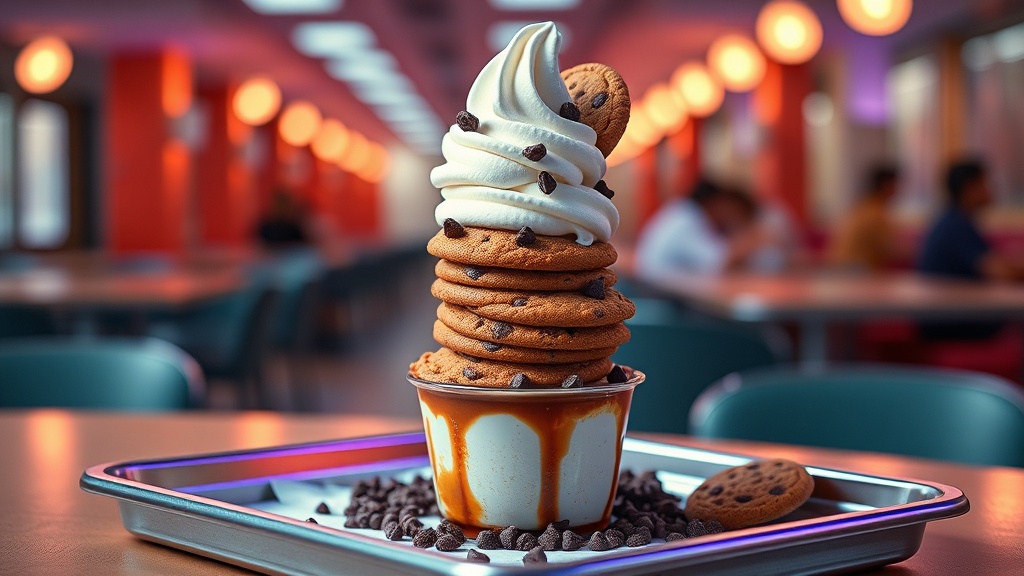
No because this week at 11:07 a.m., I watched a sophomore construct a four-layer affogato using a half-working soft-serve machine, dining hall espresso, and chocolate chip cookies that were very clearly smuggled from dessert station the night before.
I am not saying it was legal. I am saying it was art.
Why Are Campus Dining Hall Hacks Exploding in March?
Short answer: repetition plus stress creates innovation.
By mid-semester, the dining hall rotation starts feeling like a time loop: same pasta, same pizza, same salad bar chickpeas, same internal monologue.
So people stop "ordering" and start prototyping.
The economics matter too. In the College Board's 2025 Trends in College Pricing and Student Aid report, average housing-and-food budgets were about $13,900 at public four-year schools (in-state) and $15,920 at private nonprofit four-years. And at one high-profile benchmark campus, UCLA's 2025-26 posted dining rates list cash meal prices at $23 breakfast, $25 lunch, and $27 dinner.
So yes, students are trying to maximize joy-per-swipe. That is not dramatic. That is math.
How Did TikTok Turn Dining Hall Food Into Content?
TikTok turned tray-line experiments into a public performance loop.
Dining hall food used to be a private struggle. Now it has angles, voiceovers, and "wait for the reveal" cuts.
You can literally see it in the choreography: plate, pause, camera tilt, narration voice, fake casual bite.
And the platform behavior explains the speed. Pew's 2025 U.S. social media report found TikTok use is strongest among younger adults, with about half of 18-29-year-olds saying they use it daily. When daily-use behavior hits campus, one weird combo becomes a trend by Thursday.
Even small clips can pop. A 2024 Western Washington University student report covered a dining hall TikTok that crossed 300,000+ views and 44,000 likes.
One weird plate. One post. One copycat wave.
If you've read my silent walking piece, you already know this pattern: online names the behavior, campus operationalizes it.
What Is the Waffle Maker Turf War, Exactly?
The waffle maker turf war is a shared-resource etiquette system disguised as brunch.
At 11 a.m., there are two categories of people:
- People who want a normal waffle.
- People who think the waffle iron is an R&D incubator.
The unwritten rules, as documented during my very serious field research:
- If there's a line, you get one experimental batch max before rotating out.
- Do not launch a custom batter saga while someone is holding an empty plate behind you.
- Clean the drip zone. If your creation leaks, that is your civic duty.
- If you're making a savory waffle hybrid, announce yourself so nobody accidentally pours plain batter onto your jalapeno-cheddar setup.
I witnessed three near-conflicts, one passive-aggressive sigh chain, and one beautiful cinnamon-roll waffle collaboration between total strangers.
Campus peace is fragile. The waffle station proves it daily.
Why Do College Food Trends Feel So Intense Right Now?
College food trends feel intense because food is one of the few daily systems students can still customize.
College life is increasingly templated: classes, deadlines, internship panic, laundry mountain, repeat. The tray line becomes a tiny zone of authorship.
You can't control your syllabus. You can control whether your soft-serve ends up in an espresso float with crushed cookies.
Also, student demand is clearly shifting toward custom and trend-aware options. Before I get report-y: yes, the spreadsheet agrees with the vibe. Chartwells' 2025 Campus Dining Index (93,000+ respondents across 218 campuses) found strong demand for trend-forward, customizable options. About 24% said they wanted more on-trend items, and top requests included smoothies and made-to-order noodles.
Translation: students are not "too picky." They're asking for variation.
You see the same adaptation logic in other campus systems too, from 3-hour silent library dates to the broader matcha takeover conversation.
Is the Hack Economy Just Chaos or a Student Survival Instinct?
It is a student survival instinct with better plating.
I support the dining hall hack economy with two conditions:
- Don't create a biohazard.
- Don't monopolize public equipment during rush.
Everything else? I get it.
We're paying thousands for meal plans, so of course we're squeezing every ounce of dopamine out of industrial food infrastructure. That's adaptation, not entitlement.
The way that campus turned boredom into collaborative food R&D is kind of iconic.
Will some of these "Michelin" creations look cursed? Absolutely.
Will I still be at the 11 a.m. waffle line taking notes like this is Congress? Also absolutely.
FAQ: Campus Dining Hall Hacks and College Food Trends
What are the best campus dining hall hacks?
The best campus dining hall hacks are high-reward, low-chaos combos: espresso-over-soft-serve affogato, DIY grain bowls with sauce upgrades, and one-pass waffle customizations that don't hold up the line.
Why do students film dining hall food on TikTok?
Students film dining hall food on TikTok because it turns repetitive meal plans into social currency, and because short-form content rewards novelty, reveal moments, and "secret menu" storytelling.
Are campus dining hall hacks actually saving money?
Campus dining hall hacks don't reduce meal plan cost directly, but they increase perceived value by adding variety and control to food students have already paid for.
What is waffle maker etiquette in college dining halls?
Waffle maker etiquette is simple: one experimental round if there's a line, clean your mess, and don't run long custom builds during rush windows.
Are these college food trends just a phase?
Some specific combos are definitely a phase, but the broader trend, students customizing standardized food systems for novelty, has real staying power.