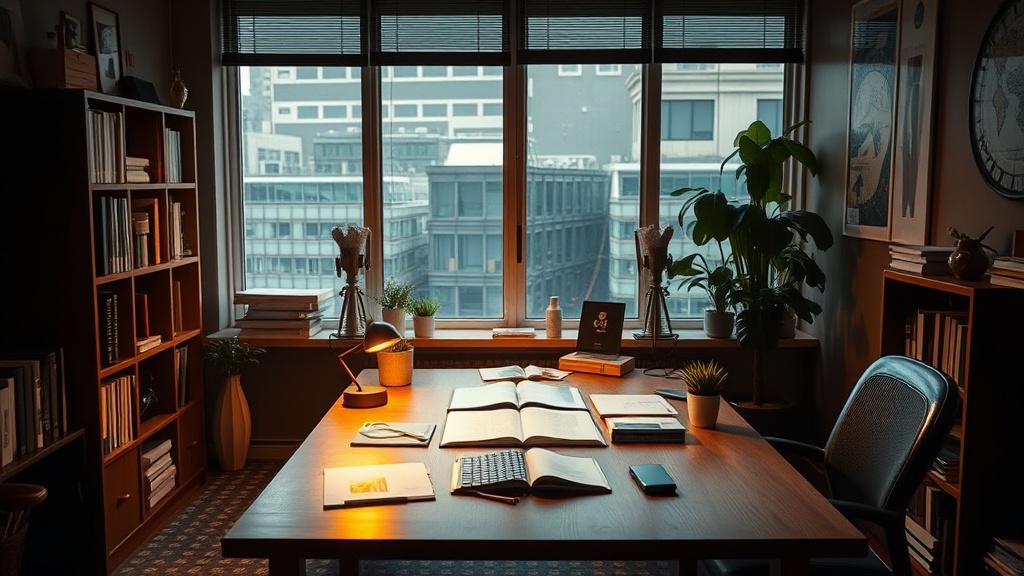
Why Your Study Space Dictates Your Mental Clarity

It’s 11:45 PM on a Tuesday. You’re hunched over a laptop in a corner of the student union, the fluorescent lights humming overhead, while a group of freshmen at the next table laughs loudly at a TikTok video. You’ve been staring at the same paragraph of your sociology textbook for twenty minutes, but the words aren't sticking. You try to focus, but the friction between your environment and your brain is palpable. This isn't just a lack of willpower; it’s a direct result of how your physical surroundings are interacting with your cognitive load. Understanding the relationship between your setting and your focus is the difference between a productive deep-work session and a three-hour cycle of unproductive scrolling.
The environment we inhabit acts as a silent partner in our academic success. When we treat every corner of campus as an interchangeable workspace, we ignore the psychological cues that certain spaces provide. A library's quiet atmosphere signals seriousness to the brain, while a coffee shop's white noise might actually be a distraction for some, but a catalyst for others. If you find yourself constantly fighting your environment, you aren't failing at studying—you're simply working in the wrong context.
Does a quiet environment actually improve focus?
The short answer is: it depends on your personality type and the complexity of the task at hand. Cognitive psychology suggests that for tasks involving high levels of "intrinsic load"—meaning tasks that require heavy logical processing or new information—silence is often the gold standard. However, for repetitive tasks or creative brainstorming, a controlled level of ambient noise can prevent the brain from becoming under-stimulated. This is why some students thrive in the rhythmic hum of a cafe, while others find it physically painful to focus in such settings.
Research into environmental psychology often highlights the concept of "cognitive load theory." When your environment is too loud, too bright, or too cluttered, your brain spends a significant amount of energy filtering out these distractions. This leaves less mental energy for the actual subject matter. If you’re trying to learn organic chemistry, you can't afford to have your brain fighting a nearby conversation. You can check more about cognitive load theories through resources like the American Psychological Association to see how external stimuli impact mental processing.
To find your ideal balance, observe your patterns. Do you feel a sense of dread when you sit down in a silent room? Or do you feel agitated when there is too much movement around you? Testing different environments—the third floor of the library, a secluded-outdoor bench, or a busy dining hall—is a necessary experiment for every student. You aren't looking for a single "perfect" spot, but rather a specific tool for a specific task.
How can I organize my dorm desk for better productivity?
A cluttered desk is often a cluttered mind, though the reality is more nuanced than a simple cliché. If your workspace is a graveyard of empty coffee cups, half-finished snack bags, and loose loose-leaf paper, your brain is constantly processing that visual noise. This creates a subtle, constant distraction. You don't need a minimalist, sterile desk, but you do need a functional one.
- The Zone Method: Divide your desk into a "digital zone" (laptop, mouse, charger) and a "physical zone" (notebook, pens, textbook). Keeping these separate prevents the feeling of being overwhelmed by too many tools at once.
- Visual Cues: Keep only what you need for the current task in your direct line of sight. If you're switching from writing an essay to reading a textbook, put the laptop away. This physical act of switching helps signal a mental transition.
- Lighting Control: If your dorm room has harsh overhead lighting, invest in a small, warm desk lamp. Soft, directional light can reduce eye strain and create a more focused, intimate atmosphere for studying.
Creating a structured workspace also means managing your digital environment. A desktop filled with a hundred unsorted files is just as distracting as a messy desk. Use a simple folder hierarchy to keep your academic life organized, ensuring that when you sit down to work, you aren't wasting twenty minutes just trying to find your syllabus.
Where is the best place to study on campus?
The "best" place is entirely subjective, but it's helpful to categorize campus locations by their psychological impact. Most campuses function as a collection of micro-environments, each with a distinct "vibe" that dictates how you will behave.
| Location Type | Best For... | V-ibe/Energy |
|---|---|---|
| Deep Library Stacks | Intense, long-term focus | Solitary, serious, silent |
| Student Unions | Collaborative work/Group projects | High energy, social, noisy |
| Outdoor Lawns/Quads | Reading/Light review | Relaxed, breezy, unpredictable |
| Coffee Shops | Casual study/Light tasks | Rhythmic, social, moderate noise |
If you find yourself stuck in a rut, move. Changing your physical location can act as a "pattern interrupt" for your brain. If you’ve been staring at a blank Google Doc in your room for an hour, the sudden change of scenery to a different building can reinvigorate your focus. This isn't about procrastination; it's about resetting your mental state through environmental change.
Don't be afraid to use the resources provided by your university. Many libraries now offer private study rooms that can be booked in advance. This is a perfect middle ground for students who need total silence but want to stay within the academic environment. You can often find more information on how to use these resources via your university's official website or student services portal.
Ultimately, your relationship with your study space is an ongoing dialogue. As the semester progresses and the difficulty of your coursework increases, your needs will shift. The heavy-duty studying required for finals week looks very different from the casual reading required during the first week of classes. Pay attention to how your surroundings affect your mood and your output, and adjust accordingly.