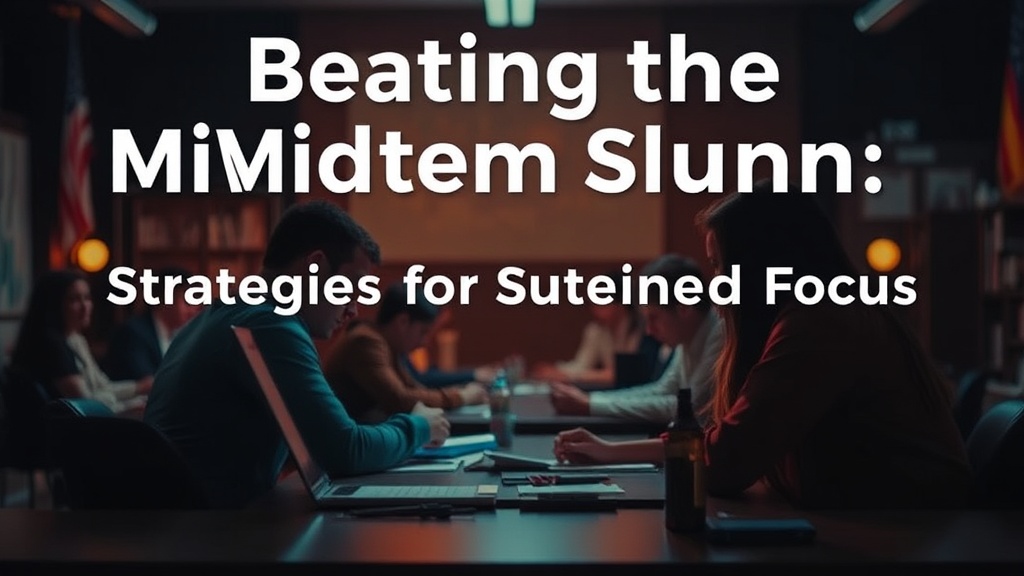
Beating the Midterm Slump: Strategies for Sustained Focus

The glow of a MacBook Pro screen flickers in a darkened corner of Bobst Library at 11:45 PM. A sophomore stares at a half-finished paragraph on macroeconomics, the cursor blinking rhythmically, almost mockingly. The caffeine from a third espresso has long since worn off, leaving behind a jittery fatigue that makes even the simplest sentence feel insurmountable. This isn't just a lack of sleep; it is the psychological wall of the midterm slump—a period where cognitive load exceeds mental endurance, and the initial momentum of the semester evaporates.
The mid-semester plateau is a predictable physiological and psychological phenomenon. As the novelty of new courses fades and the high-stakes pressure of exams approaches, the brain's ability to maintain deep work diminishes. To navigate this, one must move beyond the amateur advice of "just working harder" and instead implement structural changes to environment, biology, and cognitive management.
1. Architecting Your Environment for Deep Work
Willpower is a finite resource. If you have to fight the urge to check your phone every five minutes, you are wasting the mental energy required for your actual coursework. To combat this, you must design a physical environment that triggers a "flow state."
The Digital Perimeter
The most significant threat to sustained focus is the "notification loop." To break this, use application blockers that go beyond simple timers. Tools like Freedom or Cold Turkey allow you to lock yourself out of specific websites—such as Instagram, TikTok, or even certain news sites—across all your devices simultaneously. If you are working on a long-form essay, use the Forest app on your phone; it gamifies the experience by growing a virtual tree while you stay off your device, providing a visual incentive to remain disciplined.
The Physical Anchor
Your brain relies on environmental cues to categorize tasks. If you attempt to study in the same bed where you sleep, your brain receives conflicting signals regarding alertness and rest. Instead, identify a "high-output" zone. While the main floors of a library are standard, finding a dedicated niche can change your productivity. For those looking for a change of scenery, exploring hidden study spots on campus can provide the necessary sensory shift to reset your focus. A desk in a quiet corner of a specialized department library—such as the V&A Library for arts students—often provides a more rigorous academic atmosphere than a bustling student union.
2. Biological Optimization: Fueling the Cognitive Engine
You cannot expect high-level cognitive output from a body that is running on empty or erratic fuel. The midterm slump is often exacerbated by poor nutritional timing and disrupted circadian rhythms.
Nutritional Timing and Glycemic Control
The temptation to rely on high-sugar snacks from vending machines or quick carbohydrates from the dining hall is high during midterms. However, the subsequent "sugar crash" is a productivity killer. Instead, prioritize complex carbohydrates and proteins that provide a slow release of energy. A snack of Greek yogurt with walnuts or an apple with almond butter provides a more stable glucose level than a candy bar. Furthermore, pay attention to eating with your circadian rhythm to ensure your largest caloric intake occurs when your metabolic rate is highest, preventing the mid-afternoon lethargy that often strikes during long study sessions.
The Caffeine Strategy
Caffeine is a tool, not a crutch. To avoid the dreaded "caffeine crash," avoid consuming coffee immediately upon waking. Instead, wait 90 to 120 minutes after waking to allow your natural cortisol levels to rise. This prevents the afternoon slump. Additionally, limit caffeine intake after 2:00 PM. While it may feel like a late-night study session is necessary, the caffeine in your system will degrade the quality of your REM sleep, making you less cognitively capable the following day.
3. Advanced Cognitive Techniques
When the sheer volume of material feels overwhelming, the problem is often a lack of structure. You are not just studying; you are attempting to process an unorganized mountain of data. You need a system to categorize and tackle this information.
The Pomodoro 2.0 Method
The standard Pomodoro technique—25 minutes of work followed by a 5-minute break—is often too short for deep academic work. For complex tasks like coding or writing, try the "Flowtime Technique." Start a timer and work until you naturally feel your focus wavering. Note the time. If you worked for 50 minutes, take a 10-minute break. This allows you to capitalize on periods of intense concentration without the jarring interruption of a short timer.
Active Recall vs. Passive Review
Reading through your notes or highlighting a textbook is a form of "passive review," which creates an illusion of competence. You feel like you know the material because it looks familiar, but you cannot retrieve it during an exam. To truly master a subject, use Active Recall.
- The Feynman Technique: Explain a concept out loud as if you were teaching it to a sixth-grader. If you stumble or use jargon to hide a lack of understanding, you have found a gap in your knowledge.
- Anki or Quizlet: Use Spaced Repetition Systems (SRS). These tools use algorithms to show you difficult information more frequently and easy information less frequently, ensuring you are always working at the edge of your ability.
- Blurting: Read a chapter, close the book, and write down everything you can remember on a blank sheet of paper. Then, go back and see what you missed in a different colored ink.
4. Managing the Psychological Burden
The midterm slump is as much a mental battle as it is an academic one. The feeling of being "behind" can lead to a paralysis of analysis, where the stress of the workload prevents you from actually starting the work.
Micro-Tasking and the "Five-Minute Rule"
When a project feels too large, the brain perceives it as a threat. Break your syllabus down into the smallest possible units. Instead of "Study for Biology Exam," your task should be "Draw and label the Krebs Cycle." If you are struggling to start, implement the Five-Minute Rule: tell yourself you will only work on the task for exactly five minutes. Once the friction of starting is overcome, the momentum usually carries you forward.
The Role of Non-Sleep Deep Rest (NSDR)
If you find yourself staring at a screen for twenty minutes without typing a single word, your brain is likely overstimulated. Instead of scrolling through social media—which provides high-dopamine, low-value stimulation—try Non-Sleep Deep Rest (NSDR) or a guided Yoga Nidra session. These practices involve lying still and following a breathing pattern or mental scan. This lowers your physiological arousal and can provide a much-needed "reset" for your nervous system, allowing you to return to your desk with renewed clarity.
"Productivity is not about being busy; it is about being intentional with your energy. A student who works four focused hours is more successful than a student who spends twelve hours in a state of distracted presence."
The midterm slump is a rite of passage in the academic experience. It is a signal that your current systems are no longer sufficient for the increasing complexity of your studies. By treating your focus as a biological and environmental variable that can be engineered, you move from a state of reactive survival to one of proactive mastery. Adjust your light, manage your glucose, and refine your retrieval methods. The finish line of the semester is closer than it feels.